Ukraine: When Rebuilding Means Learning to Live Again
From Lviv to Kyiv and back to rehabilitation centres: a week of work alongside Ukrainian professionals, 30 people treated, 42 sessions delivered, and a question that has followed every mission since 2022: how do you help rebuild people when an entire country is trying to rebuild itself after war?
There is one border you cross with a document, and another you cross with memory. For us, entering Ukraine for the fifteenth time since 2022 belongs to the second category. Four years after that first journey, crossing the border again no longer simply means returning to a country at war. It means returning to people, places and faces that have become part of a story we have been building, mission after mission.
The journey begins in Poland, in Rzeszów. From there, the team heads towards the border and enters Ukrainian territory once again. There are no direct flights to simplify the journey, no easy arrival. There are roads, checkpoints, waiting and then kilometres of travel towards Lviv. It is a route we know well, but we never make it in quite the same way, because Ukraine is never exactly the same when we return.
During a week in August, the team once again moves between rehabilitation centres, railway stations, meetings with healthcare professionals and long-standing collaborators. And throughout it all, there is one reality that cannot be ignored: the war is still there.
It does not always arrive in the form of an explosion.
Sometimes it appears in a prosthesis, an amputation, a child who needs rehabilitation, or an air-raid alert that interrupts the night while you try to fall asleep and, with one eye still open, check the alert groups to understand what the next few hours might bring. It appears in a railway station where there are no tickets left, on a road that has to be travelled at night, or in a conversation about how to rebuild a life after everything has changed.
And it appears in the healthcare professionals who have been working under unimaginable pressure for years. You can see the exhaustion, even when they do not want to acknowledge it. Sometimes all it takes is a simple question — “Hi, Dimas. How are you?” — to realise, just a few seconds later, how many years these people have spent carrying the consequences of war. Some forms of exhaustion need no explanation. They can be read in a person’s eyes.
This has been Hands With Heart’s 15th mission in Ukraine. And perhaps that is why, more than a journey, it has felt like another chapter in a relationship built over four years.
Lviv: where rehabilitation begins long before walking again
Lviv is the first major point of work. For several days, the team returns to the Halychyna Comprehensive Rehabilitation Centre, an institution with which Hands With Heart has maintained a relationship for years.
Long before the full-scale invasion transformed the country’s needs, Halychyna had already developed extensive experience in rehabilitation for people living with disabilities. Its Lviv facility has a long-standing paediatric rehabilitation programme, particularly supporting children with disabilities and neurological conditions.
This is where we find Promin Nadii — “Ray of Hope” — the name still used for the paediatric area where we work. We are greeted by a seemingly endless stream of smiling children, full of energy, and their tireless mothers, who come to appointments hoping their children will make progress and, above all, hoping that one day they will have the chance to grow up under a sky that does not threaten their lives.
These are patients who need specialised care in a context where the war has altered almost every aspect of daily life. But the mission is not simply about arriving, treating patients and leaving. The work takes place alongside local teams. Knowledge, techniques, clinical reasoning and different therapeutic approaches are shared.
Ukrainian professionals know their patients, their progress and their circumstances; they coordinate our schedules, facilitate communication and bring an experience that is difficult to acquire anywhere else.
Hands With Heart, in turn, contributes its own experience and a complementary perspective. It is a collaboration that has developed over time. Fifteen missions mean fifteen opportunities to meet the same people again, encounter new cases, miss patients who are no longer there, and deepen a professional relationship that began in extraordinary circumstances and continues to evolve.
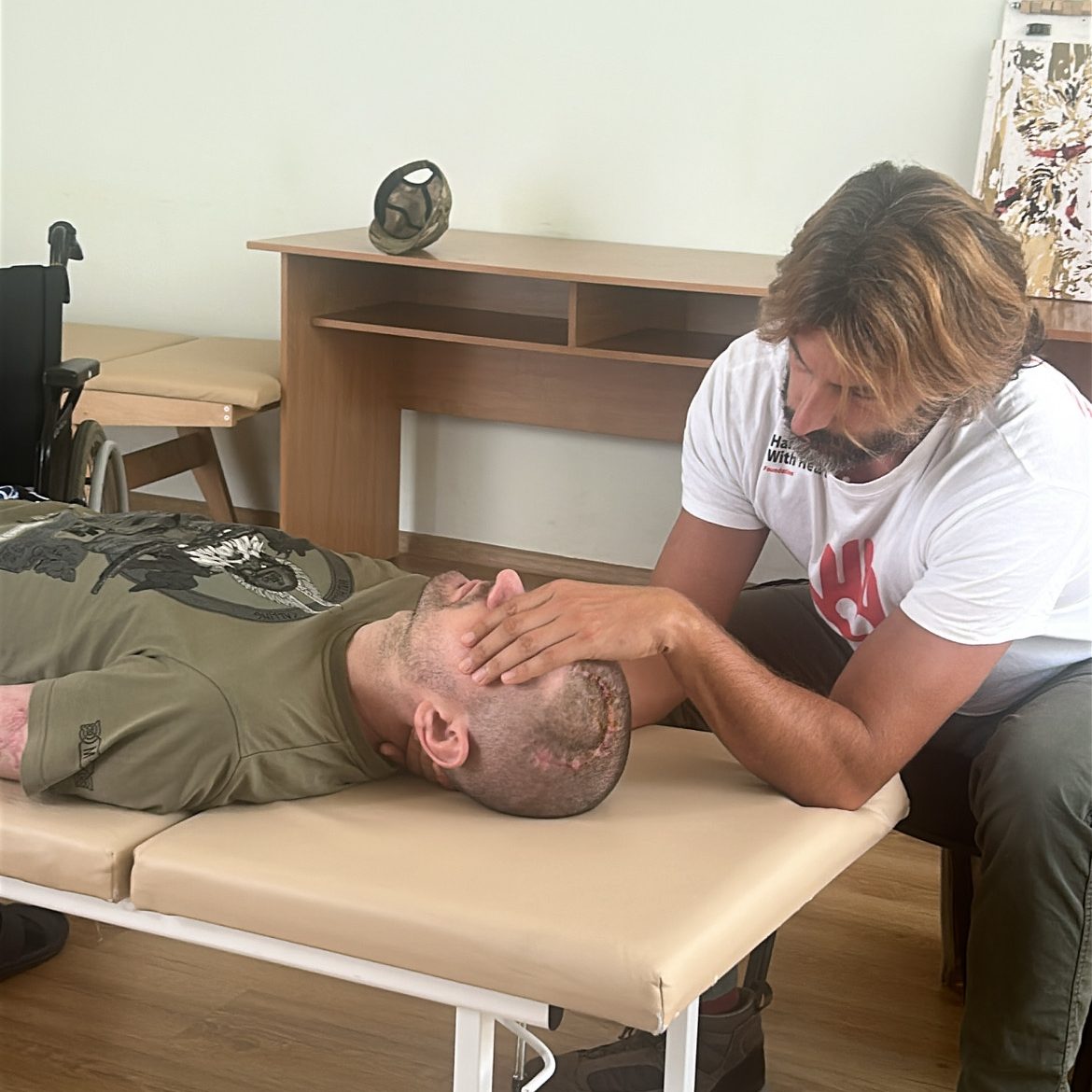
Here, osteopathy is incorporated as a complementary intervention within the multidisciplinary rehabilitation process. Treatment is adapted to each individual and to the consequences of their injury, surgery, amputation or prosthetic use. Pain. Mobility. Soft tissues and scars. Musculoskeletal and postural compensations. Respiratory mechanics.
Adaptation to a new distribution of loads. The aim is not to replace rehabilitation, physiotherapy, prosthetic care or the medical treatment these patients are already receiving. It is to work alongside them — and alongside the people who know these patients best: Ukrainian healthcare professionals.
The other side of the mission: listening to those who are already there
Something changes after fifteen missions: the relationship. Hands With Heart no longer arrives in Ukraine as an external team trying to find somewhere to help. There is now a network of professionals and collaborators with whom we have worked for years.
They are the people who open the doors of the centres, accompany us, explain, understand the real needs on the ground, guide us and make each day a little easier. It is humanity embodied in individuals who put their cars, their resources and their time at our disposal, trying in their own way to compensate for the effort they understand we make every time we travel here.
These are small gestures that may never appear in a report, but they become part of what each mission means. This mission has also given us time to ask where we can be most useful, what needs will emerge over the coming months, and how an international network dedicated to the recovery of people affected by war and disability can continue to grow.
After fifteen journeys, our perspective inevitably begins to extend beyond the next mission.
Kyiv: a night train to a city under alert
The journey to Kyiv was another story. The team spent nine hours waiting at Lviv railway station before finally boarding a train that would take us overnight to the capital. Hours of waiting, an almost entire night on the train and, eventually, arrival in Kyiv in the morning. Meanwhile, the city continued to function.
But beneath that apparent normality was a tension that is difficult to explain to anyone who has not experienced it.
During our stay, air-raid alerts once again became part of the routine. At night, we had to respond to threats of attack and follow the relevant safety protocols. The following morning, however, there were meetings. Interviews. Professionals waiting for us. People to speak with. War forces people to live with a contradiction: fear and routine can occupy the same space. Fatigue shows on the faces of everyone we meet, and it is difficult to become accustomed to the normality of sirens and explosions.
Fear arrives with every detonation. Some of us try to count the seconds, attempting to estimate how far away the latest drone or missile has exploded. Others check the alerts on their phones. Everyone develops their own ways of trying to remain calm and get some rest. It is remarkable to see how an alarm can sound repeatedly throughout the night and, just a few hours later, a city gets up and carries on.
In Kyiv, the mission also took on a different dimension. The team met with journalists from several Ukrainian media outlets interested in learning more about the work developed over these years. We also met with collaborators and contacts to better understand the situation on the ground and explore future avenues for cooperation.
The intention was to look beyond this particular mission. Because the question is no longer simply what we can do in a week. The question is what we can build for the years ahead. And Hands With Heart wants to be part of that process of human reconstruction.
A church in Kyiv and a dimension that also needs to be heard
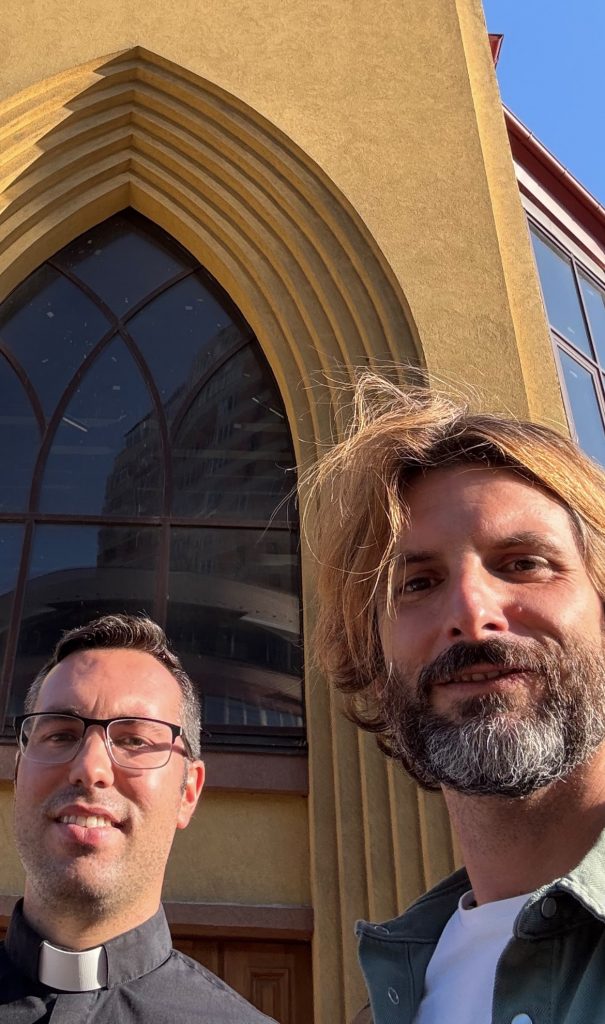
Among the meetings in Kyiv was one that was particularly meaningful. The team visited Father Pedro Zafra Gómez-Limón, a Spanish priest serving at the Parish of the Assumption of the Virgin Mary in Kyiv, who has spent these years accompanying a community that has also had to learn how to live through war. The visit was not simply institutional.
In October, Lorca will host the “Rebuilding” International Forum — Dual-use Technologies for Recovery and Resilience, an international event addressing reconstruction and resilience from three broad perspectives: the recovery of infrastructure and territories, human recovery after crisis, and the role of health technologies in emergency and reconstruction contexts.
Within the forum, Hands With Heart will coordinate the panel Human Recovery: Recovery After Crisis. The question at the heart of the panel appears simple, but perhaps it is anything but: When infrastructure has been rebuilt and services restored, what does a person — and a community — actually need in order to recover?
Because recovery after war cannot be reduced to muscles, prostheses, technology or treatment. There are also questions that do not appear in a medical record.
What happens to a person after living through war? How do they regain a sense of safety? How do they recover autonomy? How do they participate again? How do they rebuild hope? How do they feel part of a community again? And what role can meaning, spirituality and faith play?
Human Recovery seeks to open precisely that conversation: to understand recovery through the lenses of safety, health, function, dignity, participation and belonging, bringing together perspectives on rehabilitation, disability, trauma, community, spirituality, environment and person-centred innovation.
Father Pedro has experienced these years from within Ukrainian society. His perspective can offer another dimension to that process. That is why we travelled to Kyiv to meet him and personally invite him to take part in the October forum. There, we were reminded of something that is difficult to understand from a distance: a church can be a place of worship, but in the middle of war it can also become a place of refuge, companionship and community. Because some wounds can be measured and treated. Others first need to be heard.
Velykyi Liubin: when war reaches the rehabilitation centre
After Kyiv, the team travelled back towards the Lviv region. The train was not an option this time. Occupancy was at its limit, the official apps were failing and, to make matters worse, a severe evacuation alert caught us while we were queuing to buy tickets.
Running. Evacuation. Plans change within minutes. Once again, the war dictated the logistics. The alternative was to travel overnight by bus. The destination was Velykyi Liubin, home to the second site of the Halychyna Comprehensive Rehabilitation Centre. It was not, therefore, a new hospital, but another facility belonging to the same institution where we had worked in Lviv.
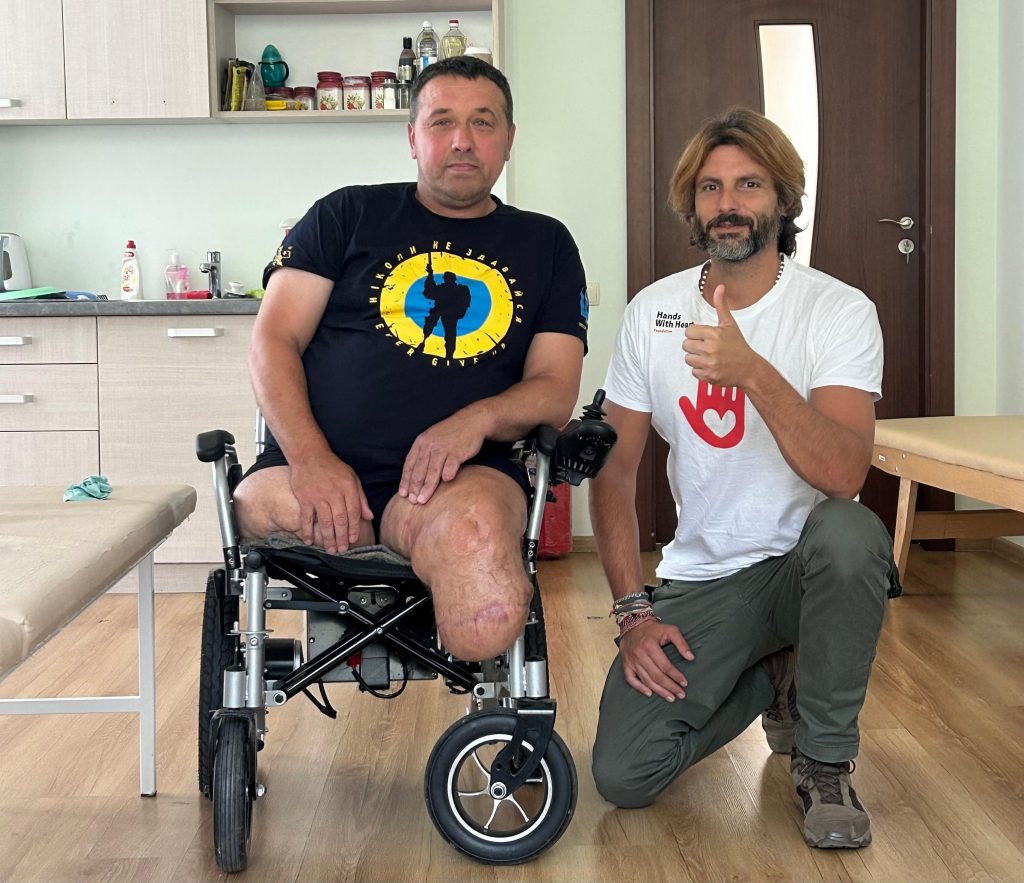
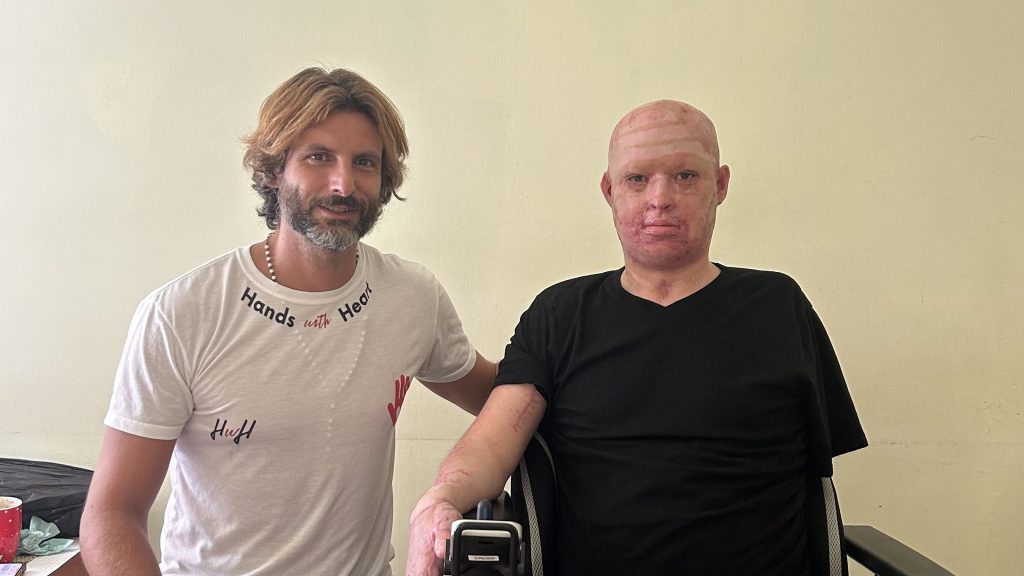
But here the war takes on another form. Soldiers and veterans arrive with serious injuries. Amputations. The consequences of explosions and mines. Surgery. Prostheses. Bodies that have to learn new ways of moving. The work of Hands With Heart once again becomes part of a much broader rehabilitation process.
For these patients, osteopathic reasoning begins with a simple question: how has the injury changed the way this person uses and organises their body? Depending on the individual case, assessment and treatment may address pain, joint mobility, soft tissues and scars, spinal and thoracic mobility, respiratory mechanics, compensations arising from amputation, and new musculoskeletal demands associated with prosthetic use.
But there is something else we need to understand. Many of these patients have spent months or years exposed to extreme situations. Sleep disturbances. Anxiety. Hypervigilance. Difficulty relaxing. Manual therapy does not seek to treat psychological trauma or replace specialised mental-health care. Its role is to provide individualised, safe physical care that is sensitive to the person’s trauma context and integrated into their wider rehabilitation process. Because recovery does not happen in separate compartments. And because learning to walk again may only be the beginning.
Thirty people and the same reality
This mission allowed us to provide care to 30 unique beneficiaries through 42 healthcare sessions. But numbers never tell the whole story.
In Ukraine, every treatment carries a story that began long before the person entered the rehabilitation room. And that story will probably continue long after the Hands With Heart team has returned to Spain. In 2022, when this relationship with Ukraine began, no one could have known there would be a fifteenth mission.
Today, there have been fifteen. Fifteen times crossing the border. Fifteen times returning to centres that have become familiar places. Fifteen times meeting professionals who continue to work. Fifteen times discovering that, although the war changes, human needs remain. This latest mission has also been a mission of learning. Of listening. Of building new alliances. Of understanding more clearly where our work needs to go.
And reaffirming a conviction that lies behind every journey: The reconstruction of Ukraine will not consist only of rebuilding buildings, repairing roads or restoring infrastructure. People will have to be rebuilt too. Those who have lost a leg. Those who have lost a part of their lives.
Those who have lived under bombardment. Those who will have to learn to walk, work, relate to others or simply imagine a future again. That is where Hands With Heart wants to be. Not only during the war. After that, too. Because rebuilding a country is essential. But rebuilding its people is what will make it possible for that country to live again.
The 15th mission is over. The work is not. We are already preparing number 16, which will take place in October. And when the time comes, we will cross the border again. Because after fifteen journeys, Ukraine is no longer simply somewhere we go. It is somewhere we return to.